News

Here you can find the latest updates on the Collaborative Research Centre "Global Dynamics of Social Policy": summaries of current research results, references to our latest publications, outcomes of events and more news from the projects and their staff members.


(c) Adobe Stock
(c) Adobe Stock
Tasks: Collaboration in the collection and preparation of datasets, collaboration in the project and literature research

We are looking for one student assistant (10 hours/week) to join the DFG-funded research project B13 "Welfare States and Protest: Understanding the Contentious Outcomes of Social Policy in Africa" of the CRC 1342 "Global Dynamics of Social Policy" (Prof. Dr. Sebastian Haunss, Prof. Dr. Sophia Hunger) starting October 1st or first possible date. The position is intended to last for one year. However, due to administrative reasons, the employment contract can initially be drawn up for only three months.

The project B13 aims to systematically analyze for one world region in the Global South (Africa) how the socioeconomic effectiveness and political integration of social policies affect the levels of contention around these policies, and how the inclusiveness and scope of benefits of social policies interact with other factors like perceived grievances, political and discursive opportunity structures, and resources available to protesters and governments. This addresses the absence of the welfare state in protest research and will provide reliable data on protests in Africa by applying state of the art LLMs and integrating multimodal information sources in the analysis.


The following tasks are waiting for you:

  • Collaboration in the collection and preparation of datasets (including web scraping and preliminary data cleaning)
  • Collaboration in the project „Welfare States and Protest: Understanding the Contentious Outcomes of Social Policy in Africa“ providing support for project-related management and administrative tasks.
  • Literature research and assistance in the preparation of data documentation.


You'll be a good fit for us if you have the following profile:

  • Studies in social/political sciences or economics or a closely related subject (BA or MA student)
  • Experience with programming skills in R and/or Python
  • Preliminary knowledge or strong interest of African social policy and protests studies
  • Motivation, commitment, ability to work in a team and to work independently
  • Willingness to learn advanced data management and NLP
  • Very good knowledge of English
  • French and/or Arabic is an asset but no exclusion restriction
  • Experience with spatial data analysis is a plus


What we offer:

  • First-hand experience with the empirical analysis of multimodal data, LLMs and reproducible research best practices
  • Support to further develop proficiency in R and/or Python
  • Flexible working hours that are compatible with your studies
  • A diverse working environment with equal opportunities


The University of Bremen is committed to equal opportunities and diversity. If you are interested, please send your application with a certificate of enrolment, a short letter of motivation, CV, transcript of records and, if applicable, relevant certificates as a single PDF file to the following e-mail address:

buero.hunger@uni-bremen.de

We encourage interested candidates to apply as soon as possible, as applications will be considered on a rolling basis and the vacancy will close once filled.

We look forward to receiving your application!


Contact:
Prof. Dr. Sophia Hunger
CRC 1342: Global Dynamics of Social Policy
Mary-Somerville-Straße 5
28359 Bremen
Phone: +49 421 218-58579
E-Mail: sophia.hunger@uni-bremen.de

(c) Adobe Stock
(c) Adobe Stock
Application Deadline: 31.08.2026

At the University of Bremen, Collaborative Research Centre (SFB) 1342 "Global Dynamics of Social Policy", Subproject A05 (Project Lead: Prof. Dr. Michael Windzio), is seeking to fill the position of a

Postdoctoral Researcher (f/m/d)
(Wissenschaftliche:r Mitarbeiter:in)

at the earliest possible date.

Salary Grade: TV-L 13
Working Hours: Full-time (39.2 hours/week)
Contract Duration: Fixed-term until December 31, 2029 (pursuant to § 2 WissZeitVG)

Note: Part-time employment is generally possible. Specific details can be arranged with the project lead if applicable.

Job description

The University as an Employer:

With approximately 20,000 students and around 3,500 employees, the University of Bremen is a medium-sized university. It is among Germany’s top research universities in terms of third-party funding and research strength.

About SFB 1342:

The Collaborative Research Centre (SFB) 1342 "Global Dynamics of Social Policy" has been funded by the German Research Foundation (DFG) since 2018. The third phase marks the capstone of this 12-year research program:

  • Phase I mapped the worldwide introduction of social protection programs and initiated the development of the Global Welfare State Information System (WeSIS).
  • Phase II captured differences in the inclusiveness and scope of social policy benefits, feeding this data into WeSIS.
  • Phase III builds on this foundation to examine the socioeconomic efficacy of social policy regarding the improvement of social conditions and the promotion of political integration.


The SFB is structured into two main project areas:

  • Area A (6 projects): Focuses on the socioeconomic and political impacts of social policy in a global comparative perspective.
  • Area B (6 projects): Primarily addresses the political and socioeconomic consequences of social policy in selected countries or regions.
  • Information Infrastructure Project (INF): Provides a shared data and methodology platform.


About Subproject A05:

Subproject A05 deals with global cultural typologies derived from dimensions such as "self-expression vs. secularization" or "independent vs. interdependent selves". Against this background, standardized text analysis methods are used to examine normative educational ideals, educational policy preferences, and recommendations of international organizations, with a special focus on the Global South.

Key Responsibilities:

  • Collaboration on joint theory development regarding universalist and multiculturalist discourses
  • Participation in developing a text classifier, as well as the organization, supervision, and execution of data annotation and text analysis
  • Co-authoring joint project publications
  • Assisting in the preparation of project reports
  • Supporting project-related research, organization, and administration


Requirements

  • An outstanding university degree (Master’s or equivalent) in Sociology, Political Science, Economics, or Psychology
  • An outstanding completed PhD with a focus on social or behavioral sciences
    Applicants in the final stage of their PhD will also be considered. Please note that presenting the doctoral degree certificate is a prerequisite for formal employment
  • Very good knowledge of quantitative empirical social research
  • Very good knowledge of standardized text analysis, text pre-processing (e.g., quanteda in R), and text analysis techniques (e.g., topic modeling and text classification)
  • Interest in analyzing global cultural typologies
  • Knowledge in the area of normative discourses surrounding liberalism, universalism, and multiculturalism


General Information

What we offer:

  • Salary: Depending on personal qualifications, an annual gross salary according to TV-L ranging between €57,112.44 (Pay Step 1) and €81,176.28 (Pay Step 6) for a full-time position. The individual pay step assignment will be determined by the university upon hiring, based on relevant professional experience. Additional benefits, such as the annual special payment ("Christmas bonus") and potential progression within the salary group, depend on this assignment and are governed by the TV-L regulations (specifically § 16 TV-L). For civil servants (Beamt:innen), remuneration is governed by the Bremen Remuneration Act (Bremisches Besoldungsgesetz)
  • Supplementary occupational pension scheme (VBL) for public sector employees.
  • 30 days of annual leave (based on a 5-day working week)
  • A diverse, forward-looking, and open workplace culture
  • Support from a collegial, motivated team with a positive working environment
  • Individual onboarding
  • Opportunities for professional development and further training
  • Work-life balance through flexible working hours (flextime) and the option for mobile work/telecommuting (subject to operational frameworks)
  • Free social and family counseling services
  • Active occupational health management, including discounted rates for local sports clubs, fitness centers, and swimming pools (EGYM Wellpass)
  • Option to obtain a subsidized public transport ticket (Job-Ticket)
  • Numerous sports and cultural activities
  • Varied dining options in the university cafeterias (Mensen)


Contact & Questions:

For general questions regarding the selection process as well as content-related inquiries about the position, please contact: 

Prof. Dr. Michael Windzio – mwindzio@uni-bremen.de

How to Apply:

Please send your application with complete and comprehensive documents (cover letter, CV, qualification certificates, transcripts) quoting reference number A149-26 by 31.08.2026 as one single PDF file via unencrypted email to:

mwindzio@uni-bremen.de and stieglit@uni-bremen.de

Or by post to: 

University of Bremen
SFB 1342 / AG Windzio
Postfach 330 440
28334 Bremen, Germany

  • Please note: Do not include photos in your application documents.
  • Please submit copies only (no folders), as we are unable to return application materials.
  • Data Protection Notice (GDPR): In accordance with Art. 6 GDPR in conjunction with § 12 BremDSGVOAG, §§ 85 et seq. BremBG, and § 15 AGG, your application documents will be stored until the expiration of the statutory period and destroyed thereafter.
  • Application costs cannot be reimbursed.


We look forward to receiving your application!


Contact:
Prof. Dr. Michael Windzio
CRC 1342: Global Dynamics of Social Policy
Mary-Somerville-Straße 9
28359 Bremen
Phone: +49 421 218-58629
E-Mail: mwindzio@uni-bremen.de

(c) Oxford University Press
Oxford University Press

Prof. Dr. Herbert Obinger and Prof. Dr. Carina Schmitt, both Directors of Project A09 "Worlds of Welfare Across the Globe. Origins and Outcomes", are members of the editorial team of The Oxford Handbook of Social Policies in the Global South. The volume was published by Oxford University Press last week and is now available.

[The Oxford Handbook of Social Policies in the Global South]

Collectively, the contributions consider three main research questions: What are the main social policies and institutions in place in the Global South? What explains their current level of development and future dynamics? And what are the outstanding factors influencing social policies in the Global South?

The volume provides a comprehensive overview of the current state of research on social policies at the global, regional, and national levels. The contributions were written with the explicit aim of offering an informed, accessible, and thorough introduction to social policies in the Global South. As such, the handbook serves as an ideal starting point for both specialists and non-specialists seeking to familiarize themselves with key themes, regions, and countries in the field of social policy in the Global South.


Contact:
Prof. Dr. Herbert Obinger
CRC 1342: Global Dynamics of Social Policy
Mary-Somerville-Straße 5
28359 Bremen
Phone: +49 421 218-58567
E-Mail: herbert.obinger@uni-bremen.de

Prof. Dr. Carina Schmitt
University of Bamberg
Feldkirchenstraße 21
96045 Bamberg
Phone: 0951-863 2734
E-Mail: carina.schmitt@uni-bamberg.de

(c) LSE
(c) LSE
Open Access

A recent article by Prof. Dr. Torben Klarl has been published in Economica, a leading international journal of economics published by the Department of Economics at the London School of Economics and Political Science (LSE). Since the beginning of the third funding phase of CRC 1342, he has contributed to Project A10, "Causal Impacts of Pension Reforms on Socioeconomic and Political Outcomes". The article has been published on an Open Access basis and is freely available to readers worldwide.

[https://onlinelibrary.wiley.com/doi/10.1111/ecca.70060]

Abstract:

This paper investigates the impact of creativity on technological advancement, long-term economic development, and social welfare, where creativity is determined endogenously through interactions within social networks. The analysis shows that an economy remains stagnant, exhibiting neither networking nor long-term growth, when the size of the creative class falls below a positive threshold. Once this threshold is exceeded, active networking between creative and non-creative individuals emerges, fostering sustained technological progress and income growth. The model is calibrated and used to simulate the transition from stagnation to sustained growth. The results indicate meaningful welfare gains from such a transition, driven by the cumulative effects of technological progress facilitated by networking.

Economica is an international journal covering research in all branches of economics published on behalf of the London School of Economics and Political Science Economics Department (LSE). It welcomes high-quality contributions from all parts of the international research community which are of interest to general readers. It is a leading economics journal, appearing high in the published citation rankings.

Torben Klarl is Professor of Macroeconomics at the University of Bremen. His research interests include artificial intelligence, climate change, political economy, development economics, and economic growth.


Contact:
Prof. Dr. Torben Klarl
CRC 1342: Global Dynamics of Social Policy, Faculty of Business Studies and Economics
Max-von-Laue-Straße 1
28359 Bremen
Phone: +49 421 218-66560
E-Mail: tklarl@uni-bremen.de

(c) Aysegül Kayaoglu
18 June 2026, Fundación Ramón Areces, Madrid

Dr. Aysegül Kayaoglu from the project A06 "Work-family Policies: Socioeconomic Outcomes and Policy Learning", presented the paper "Which Childcare Raises Maternal Employment? Public, Private and the Rationed Margin in Türkiye" at the 3rd Workshop on the Economics of Health and Human Capital, held at the Fundación Ramón Areces in Madrid on 18 June 2026.

Drawing on monthly employment histories of women combined with province-level data on childcare facilities, the paper examines how the design of childcare policy — not merely its availability — shapes maternal employment in Türkiye. It distinguishes between public and private provision and pays particular attention to the rationed margin, where demand for subsidised places exceeds supply, to identify which forms of childcare actually move mothers into work.

The workshop builds on earlier editions hosted in Madrid in 2024 and in Castellón de la Plana in 2025. Jointly organised by Universidad Autónoma de Madrid (UAM) and Universitat Jaume I (UJI), it brings together state-of-the-art econometric, data science and causal inference methods applied to questions in the economics of health and human capital. The single-day programme features ten papers, each allocated 30 minutes for presentation and open discussion, with participation capped at around twenty researchers. This year's keynote lecture was delivered by Gabriella Conti (University College London). 


Contact:
Dr. Aysegul Kayaoglu
MZES
A5, 6
68159 Mannheim
E-Mail: ayseguel.kayaoglu@uni-mannheim.de

(c) Maximilian Hohmann
Information and Exchange Meeting on 24.06.2026

Ahead of the start of the new BIGSSS cohort in September 2026, the Graduate School welcomed the new Doctoral Researchers who recently joined the CRC 1342. In addition to Professor Patrick Sachweh, Dean of the Bremen International Graduate School of Social Sciences, Dr. Regina Arant, Director of Studies, and Managing Director Dr. Christian Peters provided an overview of upcoming milestones, academic requirements, and the support services available through the Graduate School. Representing CRC 1342, the event was attended by its spokesperson Professor Sarah Berens and its Managing Director Dr. Irina Wiegand.

The Bremen International Graduate School of Social Sciences is one of Germany’s leading institutions for doctoral training in the social sciences. Its interdisciplinary programme is built around the core disciplines of political science, sociology, and psychology and is jointly operated by the University of Bremen and Constructor University. For Doctoral Researchers within the Collaborative Research Centre "Global Dynamics of Social Policy", participation in the Graduate School’s structured doctoral training programme forms an integral part of their academic qualification and professional development.


Contact:
Dr. Irina Wiegand
CRC 1342: Global Dynamics of Social Policy
Mary-Somerville-Straße 5
28359 Bremen
Phone: +49 421 218-58508
E-Mail: irina.wiegand@uni-bremen.de

(c) Maximilian Hohmann
Jour Fixe with Prof. Lengwiler on 17.06.2026

On 17 June 2026, Prof. Martin Lengwiler from the University of Basel delivered the final guest lecture of the current summer semester as part of the CRC 1342 Jour Fixe series. The Swiss historian presented results of his research on the diffusion of commercial insurance in East and West Africa. He was invited by Prof. Delia González de Reufels, Project Director of Project B15 and Dean of Faculty 08: Social Sciences at the University of Bremen.

Abstract:

This paper presents the results of a historical research project examining the diffusion of commercial insurance in non-Western countries. It focuses on sub-Saharan Africa, particularly East and West African countries, from the late colonial period to the early decades of independence (1940s–1980s). During the colonial era, insurance was primarily available to Western communities and local elites. After independence, the development of insurance markets depended on political and socio-economic conditions. In socialist countries such as Tanzania and Ghana, the insurance industry was nationalised and campaigns were launched for its 'Africanisation', but these countries still depended on Western expertise and reinsurance. In Western-oriented countries such as Kenya and Nigeria, markets were driven by competition between African and European companies. The growth of commercial insurance markets, especially life insurance, was also limited by the social welfare programmes of independent African governments. This paper discusses the factors that have shaped the development of African insurance markets and highlights the role of regional and international organisations (e.g. UNCTAD).

Martin Lengwiler is Full Professor of Modern European History at the University of Basel. He received his Habilitation degree at the University of Zurich in 2004 and has since held several visiting and substitute professorships, including at the Ecole des Hautes Etudes en Sciences Sociales (2009) and at the University of Basel (2006-2009). He was a Fellow at the Historical Research Institute, University of California, Irvine in 2001. He is also an associate member of the Science Policy Project Group at the Social Science Research Center Berlin (WZB). In 2009, he was appointed to an assistant professorship with tenure track (Modern European History) at the University of Basel. In 2012, the position was converted into a full professorship.


Contact:
Prof. Dr. Delia González de Reufels
CRC 1342: Global Dynamics of Social Policy, Institut für Geschichtswissenschaft / FB 08
Universitäts-Boulevard 13
28359 Bremen
Phone: +49 421 218-67200
E-Mail: dgr@uni-bremen.de

(c) Maximilian Hohmann
13 June 2026, University of Bremen

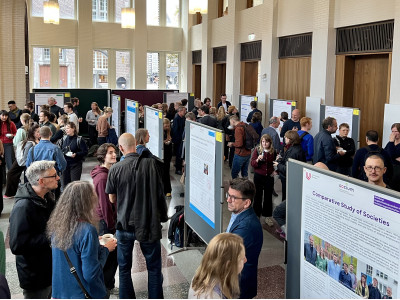
Together with the Research Institute Social Cohesion (RISC), the Collaborative Research Centre Global Dynamics of Social Policy participated in the University of Bremen's Open Campus on Saturday, 13 June 2026, with its own information booth. At more than 40 exhibition stands, numerous visitors explored opportunities and gained insights into studying, research, internships, and working at the university. The Open Campus was held under the motto "Open Worlds – Share Knowledge."

Further information: OPEN CAMPUS 2026 - Universität Bremen


Contact:
Dr. Maximilian Hohmann
CRC 1342: Global Dynamics of Social Policy
Mary-Somerville-Straße 3
28359 Bremen
Phone: +49 421 218-57058
E-Mail: hohmann@uni-bremen.de

(c) Zoom
(c) Zoom
Online-Workshop on 29 May 2026

On Friday, 29 May 2026, the new colleagues who joined the Collaborative Research Center 1342 as part of Phase III had the opportunity to familiarize themselves with the "Global Welfare State Information System (WeSIS)". Dr. Nils Düpont, a member of the CRC since its first phase, provided a professional introduction to the system and, through five concise exercises and practical advice, successfully conveyed the fundamentals of working with WeSIS to the participants.

During the one-hour workshop, both general conceptual questions and more detailed application possibilities were discussed.

Registration and further information are available at: https://wesis.org/


Contact:
Dr. Nils Düpont
CRC 1342: Global Dynamics of Social Policy
Mary-Somerville-Straße 7
28359 Bremen
Phone: +49 421 218-57060
E-Mail: duepont@uni-bremen.de

(c) Maximilian Hohmann
Jour Fixe with Prof. Sulitzeanu-Kenan on 20 May 2026

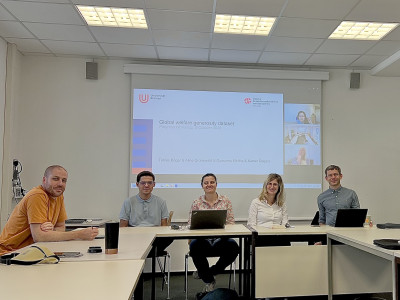
At the invitation of CRC Spokesperson Prof. Dr. Markus Tepe, Prof. Raanan Sulitzeanu-Kenan from the Hebrew University of Jerusalem visited Bremen. On 20 May 2026 he gave a lecture entitled "The Curse of Highly Effective Social Policies: Empirical Implications of a Theoretical Model". The event was held in a hybrid format, enabling colleagues from other universities to participate as well.

Abstract:
How can we explain cases in which effective social policies become neglected by policymakers and citizens alike? Highly effective policies reduce the visibility of the social problems they address (e.g., poverty, poor health, inequality), thereby creating the illusion that the problem has been solved. As a result, beneficiaries may become less politically active, as the urgency that once motivated mobilization declines, and voters may similarly shift their attention toward other issues. These dynamics, in turn, create opportunities for opponents (e.g., austerity advocates, science skeptics) to argue that the policy is no longer necessary or has become too costly. Political support for a social policy may therefore erode because it succeeded, not because it failed. This study investigates this curse of highly effective social policies by developing a theoretical model that captures these self-undermining dynamics and generates several unintuitive predictions about the relationship between a policy’s effectiveness and the temporal evolution of public support and funding.

Raanan Sulitzeanu-Kenan is a Professor of Public Policy at the Hebrew University of Jerusalem. He earned his DPhil in Political Science from Oxford University. His research focuses on behavioral public administration, political behavior, and empirical legal studies, with a prolific publication record exploring topics such as public sector honesty, proportionality in policy, and the reputational dynamics of administrative agencies. He served as the Head of the Federmann School of Public Policy (2017-21), and as Vice-Dean of Teaching at the Faculty of Social Sciences (2023-26) at the Hebrew University.


Contact:
Prof. Dr. Markus Tepe
CRC 1342: Global Dynamics of Social Policy
Mary-Somerville-Straße 5
28359 Bremen
Phone: +49 421 218-58520
E-Mail: markus.tepe@uni-bremen.de