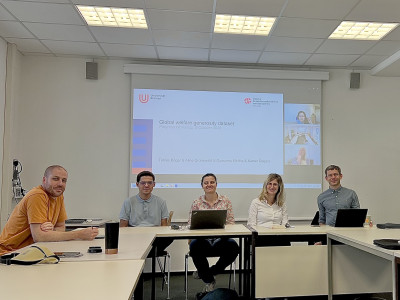



The Doctoral Researcher from completed Project A04 "Global Developments in Health Care Systems" presented her cumulative dissertation, which was awarded the distinction Magna Cum Laude, on 19 October 2026. Entitled “The Middle East and North Africa’s Pursuit of Universal Healthcare Coverage: A Multi-dimensional Analysis of Progress,” the dissertation was supervised by Dr. Lorraine Frisina-Doetter and Prof. Dr. Klaus Schlichte.
This cumulative dissertation examined progress towards universal health coverage (UHC) in the Middle East and North Africa (MENA). It focused on five dimensions that influence UHC outcomes at the de jure and de facto levels, namely global factors, the wider structural context, health-system arrangements, formal healthcare entitlements, and social determinants such as citizenship and labour-market segmentation. Guided by the interdependencies framework of Nullmeier et al. (2022), it adopted a multidimensional perspective on UHC in which the global normative agenda is being mediated through the aforementioned national constellations.
The dissertation comprises three articles. The first paper analysed both the World Health Organization’s (WHO) reports and primary data from domestic legislation in Egypt and Morocco to examine the extent of alignment between health-insurance reforms and WHO recommendations between 2010 and 2022. The second article used a scoping review to collect information on enablers and barriers to UHC identified across three country cases representing varying income levels and service coverage scores: the United Arab Emirates, Morocco and Yemen. The third article used primary legislative data from legal texts and quantitative data from national surveys and ministerial reports to compare formal healthcare entitlements and nationality-disaggregated healthcare utilization among citizens and expatriates across the six Gulf Cooperation Council countries, drawing on complementary evidence concerning financial protection, unmet need and healthcare responsiveness.
Together, the studies highlight the importance of examining UHC beyond aggregate coverage indicators, formal entitlements and finance-centred perspectives. They demonstrate the value of considering international influences, domestic institutional conditions and societal differences to understand the varied pathways towards UHC across the region. The dissertation contributes to the fragmented literature on health determinants and to MENA literature that focuses on health-system barriers without linking them to de jure entitlements or situating the global normative agenda within those discussions. It also contributes to the literature on health equity, which focuses on inequities between different groups of citizens, and to the regional literature on the Gulf, which focuses on specific health domains or specific groups of migrants. Through this, it shows both patterns and variations in health policymaking in the MENA region.
Contact:
Mai Mohamed Abdou Mahmoud